When someone asks whether there is more psilocybin in magic truffles or hallucinogenic mushrooms, the quick answer would be: it depends. Yes, we know, the classic textbook answer. But here’s the interesting part: it doesn’t depend only on whether we’re talking about a “truffle” or a “mushroom,” but also on whether the product is fresh or dried, the species, genetics, storage conditions, and even which part of the fungus is being analyzed.
In other words, this isn’t like comparing two soft drinks by looking at the label. There are more variables here than in a conversation at 4 a.m.
What exactly is psilocybin?
Psilocybin is a naturally occurring compound found in some psychoactive fungi. Put simply, it is one of the molecules responsible for the psychedelic effects of certain mushrooms and truffles.
But here’s the thing: the main active compound is not usually just psilocybin in its original form. Once it enters the body, psilocybin is converted into psilocin, which interacts more directly with certain receptors in the brain. Even so, when people talk about the potency of truffles and mushrooms, psilocybin is generally the main reference point.
Truffles and mushrooms: they’re not the same thing, even if they’re part of the same world
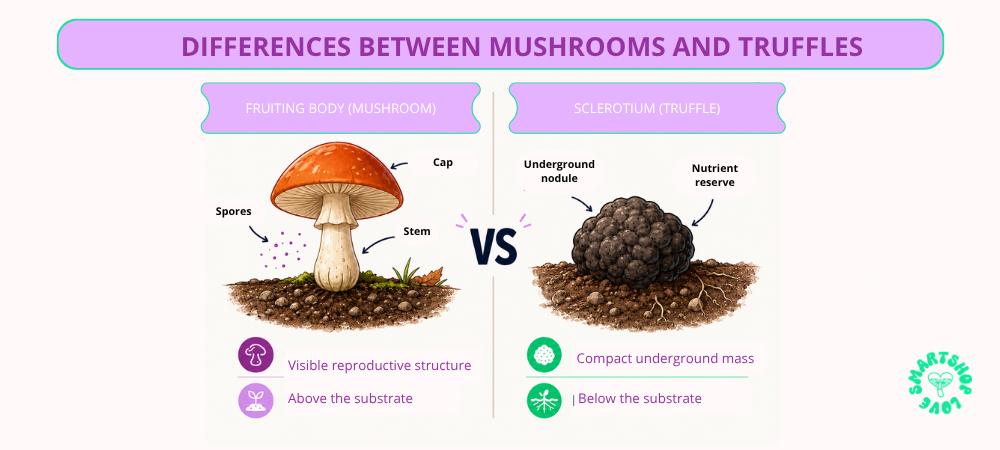
Hallucinogenic mushrooms are the fruiting bodies of the fungus. In other words, they are the visible part that is typically associated with the classic image of a “magic mushroom.”
Magic truffles, on the other hand, are not culinary truffles or those black diamonds shaved over pasta for the price of half a paycheck. They are actually sclerotia: compact structures made of mycelium that some fungi form as a reserve and means of protection.
To keep it simple:
- Mushroom: the part that grows outward.
- Magic truffle: a compact underground or internal mass formed by the mycelium.
- Psilocybin: the compound that can be present in both, but in varying amounts.
And this is where things get really interesting when it comes to mushrooms, magic truffles, and psilocybin.
So, which contains more psilocybin: truffles or mushrooms?
In general, dried mushrooms tend to have a higher concentration of psilocybin per gram than fresh truffles. But there’s a catch, because we are comparing two different formats.
Magic truffles are usually found fresh, with a high water content. Mushrooms, in many contexts, are compared in dried form, after losing much of their water. And of course, when you remove water, everything becomes more concentrated, including psilocybin.
It’s like saying that a raisin has more sugar per gram than a fresh grape. It’s not black magic: the raisin has simply been dehydrated.
That’s why, when someone asks, “Which contains more psilocybin?”, another question should immediately come to mind:
Are we comparing fresh truffles with fresh mushrooms?
Fresh truffles with dried mushrooms?
The same fungus or different species?
A properly stored product or something that has been sitting in a drawer for months?
Otherwise, comparing the products and the amount of psilocybin they contain becomes about as crooked as a patio chair.
Moisture completely changes the comparison
This is the key point of the post: water matters.
Fresh mushrooms contain a lot of water. When they are dried, they lose much of their weight, but the active compounds become more concentrated in a smaller amount of material. That’s why a dried mushroom may seem “more potent” per gram than a fresh one.
The same applies to truffles, but they are often sold or described in fresh form. As a result, gram for gram, they may appear less concentrated than dried mushrooms when it comes to psilocybin.
And if someone skips over that detail, they’re probably mixing apples and oranges, along with a lab-coated gnome.
Do Truffles Have Less Psilocybin Than Mushrooms?
As a general rule, magic truffles are often considered less concentrated than many dried mushrooms. But that doesn’t mean all truffles are “weak” or that all mushrooms are “strong.”
The amount of psilocybin can vary considerably depending on:
- The mushroom species.
- The specific variety or strain.
- Whether it is fresh or dried.
- The part being analyzed.
- Storage conditions.
- Time since harvesting.
- Cultivation or growing conditions.
So the classic claim that “mushrooms hit harder than truffles” can be a useful generalization, but it’s not a universal law carved in stone by the neighborhood shaman.
Species Matter More Than You Might Think
Not all mushrooms and truffles come from the same type of fungus. Some Psilocybe species can form sclerotia, while others are better known for producing fruiting bodies.
This matters because psilocybin production is not identical across all fungi. Some species are better known for their potency, others are milder, and some have highly variable profiles.
There can also be differences within the same species. Two samples with the same commercial name don’t necessarily contain exactly the same amount of psilocybin. And this is where marketing sometimes puts on a wizard’s robe and starts throwing around epic names as if they were video game characters.
Psilocybin and Psilocin: The Duo Putting on the Show
Psilocybin acts as a kind of precursor. When metabolized, it is converted into psilocin, which is more directly associated with psychedelic effects. In addition, some mushrooms may also contain psilocin in varying amounts.
Why does this matter? Because focusing only on psilocybin can leave out part of the picture if we want to understand the mushroom’s overall profile.
More detailed analyses may also identify other related compounds, but the main conversation usually revolves around this duo: psilocybin and psilocin.
Basically, the dynamic duo of the mind trip. But without the cape, without the Batmobile, and with considerably more respect.

Why Isn’t There an Exact Figure for Truffles and Mushrooms?
Because nature doesn’t work with spreadsheets. You can find general ranges, sure. You can read analyses, studies, and comparisons too. But there is no universal figure saying, “all truffles contain X psilocybin and all mushrooms contain Y.” That would be wonderfully convenient, but it wouldn’t be true.
Psilocybin levels can vary depending on the type of mushroom, drying, oxidation, storage, and even the analytical method used. That’s why any serious content should discuss ranges, variability, and context rather than presenting fixed magical numbers.
And if someone promises you an exact answer for everything, be careful: they might not be informing you—they might just be selling smoke and glitter.
So, Which Wins: Truffles or Mushrooms?
If we’re talking about concentration per gram, especially in dried form, many mushrooms tend to be more concentrated than fresh truffles.
But if we’re talking about the actual experience, things get more complicated. Psilocybin isn’t the only factor. The condition of the product, individual sensitivity, context, mental state, environment, and other compounds present in the fungus can also play a role.
So, the most honest answer would be:
Dried mushrooms usually contain more psilocybin per gram than fresh truffles, but you can’t generalize without considering the species, format, and specific analysis.
| What people usually say | Is it correct? | The lab-coat-free explanation |
|---|---|---|
| Mushrooms contain more psilocybin than truffles | Only partly | This is usually true when comparing dried mushrooms with fresh truffles, but it is not a universal rule |
| Truffles are weak | Too simplistic | They may be less concentrated per gram when fresh, but that does not mean they contain no psilocybin |
| A dried mushroom is always more potent | No | The species, batch, drying process, and storage conditions can significantly change the result |
| The shape of the fungus determines its potency | Not exactly | The form helps distinguish a mushroom from a sclerotium, but potency depends more on chemistry, moisture, and variety |
| If it is dry, it contains more psilocybin | Not exactly | Drying concentrates what is already there by removing water, but it does not create new psilocybin |
| An exact percentage can be given for all of them | Not a chance | Psilocybin can vary significantly between species, samples, and conditions |