
Hyphae and mycelium are two basic concepts for understanding how fungi grow, and the difference between them is much simpler than it sounds. A hypha is a tiny filament, while mycelium is the network formed by many of these filaments as they grow and branch out. In other words, behind those biology-exam-sounding terms lies a pretty straightforward explanation.
And the interesting thing is that much of the life of many fungi takes place right there, in that network that usually remains hidden while the mushroom gets all the attention.
What are hyphae?
To understand what mycelium is, we first need to get to know the building blocks that make it up. And those building blocks are hyphae.
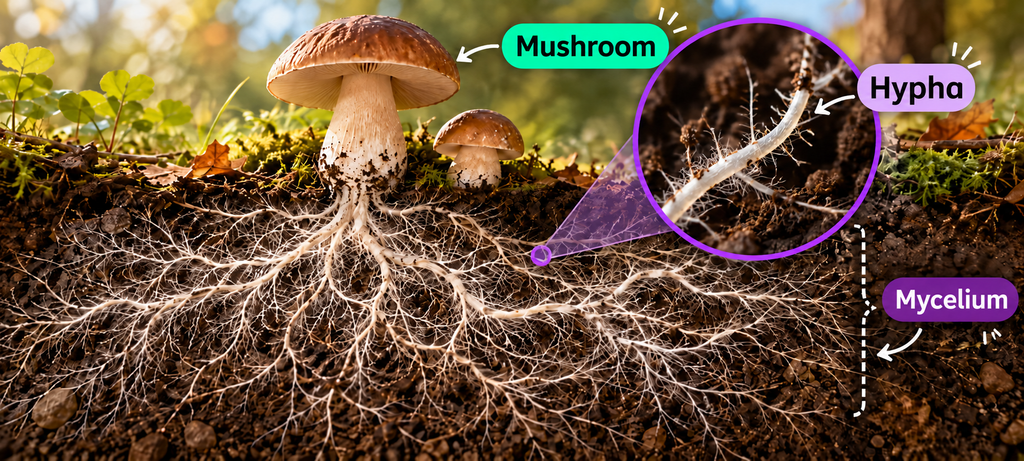
A hypha is a very thin filament that forms part of the structure of many fungi. To put it simply, imagine a microscopic thread that keeps growing, spreading and branching out through the environment where the fungus develops.
These filaments can spread through soil, wood, organic matter or other substrates, depending on the species. As they grow, they help obtain the nutrients the organism needs.
A single hypha is usually too small to distinguish with the naked eye. Things start getting interesting when huge numbers of them appear and begin intertwining.
And that’s where our next main character comes in.
What exactly is mycelium?
Now bring a whole bunch of hyphae together, and the fun begins.
Mycelium is the collection or network formed by a fungus’s hyphae. In other words, if a hypha is a thread, mycelium is the entire fabric woven from those threads.
This network can grow across a surface or spread through soil, wood, organic matter and other materials. In many fungi, it forms a fundamental part of their vegetative structure and can occupy a much larger area than the mushroom we see above ground.
This is where a very common comparison comes in: describing mycelium as “the roots of a fungus”.
It’s a useful way to picture it, but it isn’t literally correct. Fungi don’t have roots like plants do. Mycelium can perform some comparable functions, such as spreading through its environment and helping obtain nutrients, but biologically they are different structures.
So now you know: calling them “roots” to help explain the idea is fine. Saying they’re actual roots? Not so much.
Difference between hyphae and mycelium: it couldn’t be simpler
Now for the million-dollar question: what is the difference between hyphae and mycelium? If you’re still mixing up the two concepts, this table makes everything crystal clear.
The simplest way to explain the difference between hyphae and mycelium is this: A hypha is a thread. Mycelium is the entire fabric.
Hyphae grow and branch out, forming increasingly large networks. That network is precisely what we call mycelium.
So, is mycelium the fungus?
Here’s another pretty common misconception. We see a mushroom growing out of the ground and automatically think, “That’s the fungus.”
Well, there’s a little more to the story.
In many fungi, the mushroom we see is the fruiting body or the mushroom grow kit, a structure associated with reproduction. Meanwhile, the mycelium can remain spread throughout the substrate without attracting much attention.
In other words, the mushroom is the celebrity that appears in all the photos, but underneath there may be an entire network of hyphae and mycelium doing all the hard work behind the scenes.
That’s why mycelium can exist even when there are no visible mushrooms.
It also explains why identifying a fungus solely by the part sticking out of the ground means you’re only seeing part of the bigger picture.
From spore to mycelium: How it all begins
We already know what hyphae are and what mycelium is, but there’s still one fairly logical question: where does all this come from?
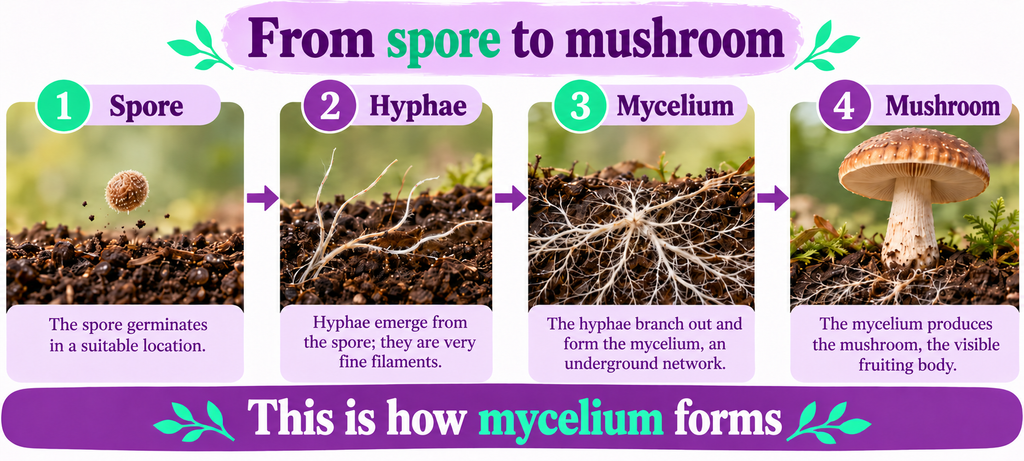
To put it very simply, many fungal species can begin their development from a spore. When it encounters suitable conditions, it germinates and begins producing filamentous structures. These hyphae continue growing and branching out until they form a mycelial network.
Here’s an easy way to visualise the process:
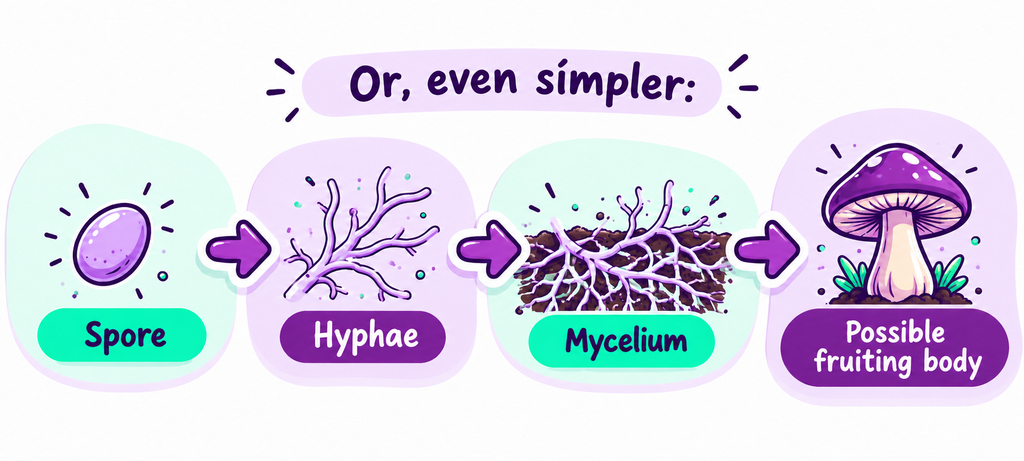
Of course, this is a simplified explanation. The fungal kingdom is enormous, and not all species follow exactly the same life cycle.
Hyphae, Mycelium, Spores and Mushrooms: Understanding each one
Now that we’re getting into the details, there are four terms worth distinguishing because they often get lumped together.
They’re not synonyms or different ways of referring to the same thing.
The relationship between them becomes much clearer when you follow the process described above.
A spore can germinate and produce filamentous growth. The hyphae spread and form the mycelium. And some fungi, when the right conditions are met, can develop visible reproductive structures such as mushrooms.
So no, a mushroom, a spore, a hypha and mycelium aren’t four fancy ways of saying “fungus”. Each one has its own role.
What do Hyphae and Mycelium do?
Right, now we know how to tell them apart. Next, let’s find out what on earth they actually do.
Fungi don’t eat like we do, nor do they produce their own food through photosynthesis like plants. In many species, hyphae spread through their environment, release enzymes that help break down materials and then absorb the available nutrients.
This way of growing has a pretty obvious advantage: a network made up of extremely thin filaments can spread out and come into contact with a huge amount of substrate.
Exploring their surroundings
Hyphae continue growing and branching out.
Thanks to this growth, mycelium can spread into new areas of the substrate in search of resources.
Obtaining nutrients
Hyphae are in direct contact with the environment in which they grow and play a role in external digestion and the subsequent absorption of nutrients.
In other words, mycelium isn’t just there to look pretty.
Forming a network
As hyphae continue branching out, they can form an enormous network made up of tiny structures.
An individual hypha may require a microscope to be seen clearly, while a mass of mycelium can become perfectly visible to the naked eye.
Can you see mycelium with the naked eye?
Here’s a pretty interesting fact: a single hypha can be an expert at hide-and-seek, but millions of them together are a completely different story.
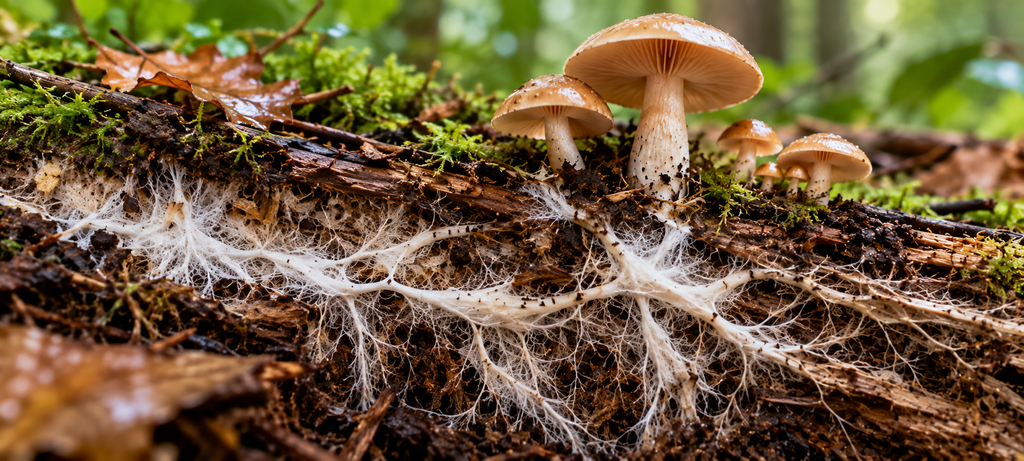
A mass of mycelium can become visible to the naked eye. Its appearance can vary depending on the fungus and where it grows. Kew explains, for example, that mycelium can appear as fuzzy-looking masses and is actually made up of an entire network of extremely fine filaments called hyphae.
The important thing is to avoid another oversimplification: seeing something filamentous or whitish doesn’t automatically tell you which fungal species you’re looking at.
Appearance can provide clues, but mycology doesn’t work on the principle of “it’s white, so it must be mycelium, case closed”.
Hyphae and Mycelium: What you need to remember
After all those unusual scientific terms, the difference between hyphae and mycelium is still incredibly simple.
A hypha is an individual filament. Mycelium is the network formed by many of these filaments.
Hyphae grow, branch out and spread through their environment. When they develop together, they form the network we know as mycelium, which can remain hidden even when there isn’t a single mushroom in sight.
So the next time someone asks you what hyphae are, there’s no need to pull out an 800-page encyclopaedia.
Hypha = thread. Mycelium = network of threads.
It might sound like something out of a mad scientist’s vocabulary, but in the end, there’s really not that much mystery to it.