Truffle microdoses sit in that strange space where science, word-of-mouth, and the classic “it changed my life” story all coexist—usually accompanied by an intense stare and an oat milk coffee. And let’s be clear: just because something becomes trendy doesn’t make it false… but it also doesn’t make it a miracle.
In this Smartshop Love guide, you’ll find what really matters: what they are, what the evidence says, what risks exist, and how to approach the topic with a clear head so you don’t turn your mental health into a “I saw it on TikTok” experiment.

What truffle microdoses are
When we talk about truffle microdoses, we’re referring to very small amounts that, in theory, aim to produce subtle effects without triggering an intense experience. In other words: it’s not about “seeing colors” or having deep conversations with a lamp. It’s about whether there are day-to-day changes in mood, stress, energy, or focus.
But here comes the first useful reality check:
- Microdosing is not therapy. Therapy involves assessment, goals, and clinical follow-up.
- Microdosing does not mean harmless. “Small” is not the same as “safe for everyone.” Institutions such as the NCCIH warn about possible adverse effects even at microdose levels (insomnia, anxiety, low mood, etc.).
Truffles vs. mushrooms: the difference that actually matters
“Magic truffles” are typically sclerotia (storage structures) that may contain psilocybin/psilocin. Practically speaking, this matters because it affects storage, format, and how experiences can vary between individuals or batches.
Why people look for truffle microdoses
Because there’s usually a real issue behind it. Nobody starts here thinking: “I’d love to optimize my mental rumination.”
- ongoing stress and “too many tabs open in your head”
- apathy and low motivation
- mild/moderate anxiety and constant tension
- desire for clarity and emotional balance
Truffle microdosing and mental health: what the evidence says
Big question: do truffle microdoses help mental health?
Honest answer: there are interesting signals, but no solid consensus yet, and placebo/expectation effects may play a significant role.
What studies and self-reports show
In observational studies, many people report improvements in mood and well-being. The issue is that observation is not proof: changes in habits, motivation, environment, and expectations may all influence results.
The mind’s “trick”: placebo, expectation, and bias
In microdosing, it’s easy for the brain to act like a “detective” and find changes where it expects them. That’s why researchers have used designs such as self-blinding, which aims to separate drug effects from expectation effects. This suggests that part of the reported benefits may be explained by placebo/expectation.
So is it all hype?
Neither black nor white. What is clear: it should not be presented as a clinical “solution” for anxiety or depression without nuance. The NCCIH emphasizes caution and highlights risks and unpredictability outside supervised settings.
Real risks of truffle microdosing (yes, even if it’s “micro”)
Possible side effects
Microdosing has been associated with insomnia, anxiety, low mood, physical discomfort, and difficulties in social or work performance in some individuals.
When it’s NOT a good idea to “just try it”: If there is a personal or family history of psychosis, severe disorders, or significant emotional instability, caution is not optional.
Medication and interactions: don’t improvise: If you are on psychiatric medication or other relevant treatments, the responsible approach is to speak with a healthcare professional. This isn’t “overcautious advice”—it’s basic safety when mental health is involved.
“`html “`Responsible approach (the one that actually gives you clarity): intention + context + tracking
If your plan is “I’ll see if it fixes my life,” what you probably need is not a microdose… it’s sleeping 8 hours and leaving your phone outside the bed. Seriously now: the most sensible approach is to measure and understand.
Intention: define what you want to improve
The brain loves vague goals (“I want to feel better”), but real changes are detected with simple metrics: sleep, stress, mood, focus.
Context: your routine may be doing 80% of the work
Sometimes change comes from the least glamorous things:
- consistent sleep schedule
- daily movement
- less caffeine in the afternoon
- less nighttime screen exposure
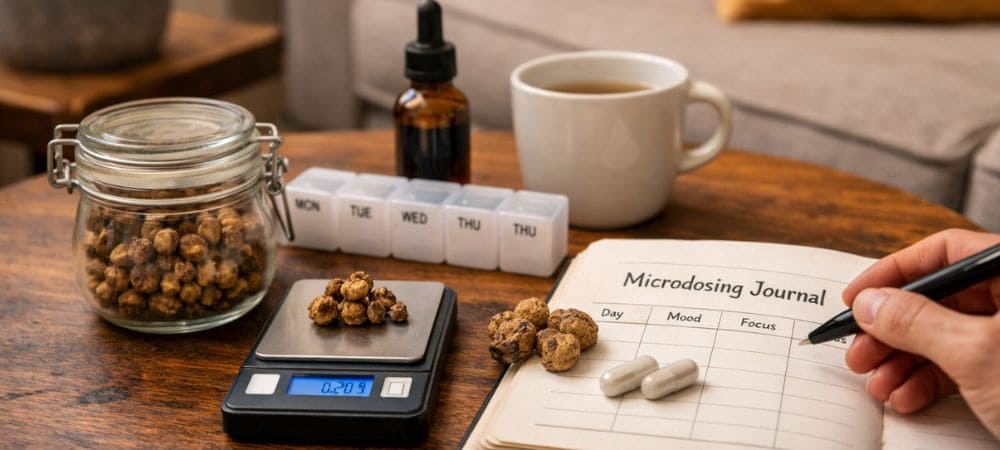
Tracking: the secret weapon to avoid self-deception
If you want to know whether something affects you, track it. Because emotional memory is creative: when you feel good, “everything was fine”; when you feel bad, “I’ve never been well.”