
Magic truffles and hallucinogenic mushrooms have been at the center of the same old debate for years: are they the same thing? Which one will send you to Mars first? Which one should I start with if I don’t want to end up talking to my living room ficus?
If you’ve ever asked yourself any of these questions, you’re in the right place. Let me clear it up for you right now: they are not the same. Their effects are similar but not identical, and choosing correctly can make the difference between a trip worth talking about later and a horrible afternoon you’ll want to forget. Let’s get to it.
What exactly are magic truffles and hallucinogenic mushrooms?
Before we compare, let’s get things straight. Some people use “magic truffle” and “magic mushroom” as if they were synonyms. Psychedelics 101 mistake.
Magic mushrooms: the fruiting body of the fungus
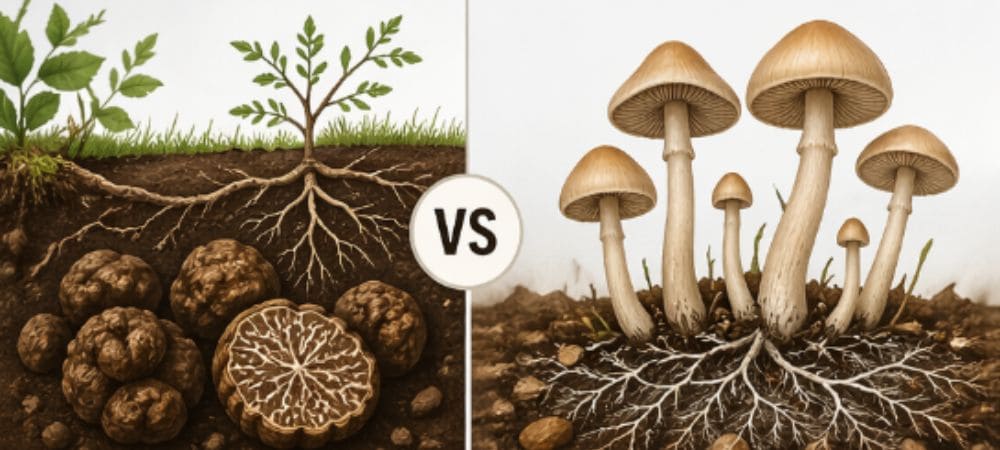
These are the ones you see in movies. The body of the fungus, with its stem and cap. They grow upwards, release spores, and are the life of the party. If we’re talking about Psilocybe cubensis, we’re talking about the old school; Psilocybe semilanceata is the typical one found in damp meadows, and Psilocybe azurescens is an absolute powerhouse. All hallucinogenic mushrooms share the same compound responsible for their effects: psilocybin.
Magic truffles: sclerotia, not culinary truffles
Here comes the plot twist. These aren’t the truffles you put on pasta. They are sclerotia. Basically, it’s the fungus’s “Plan B.” When conditions outside get tough, the mycelium compacts underground to survive. It’s like a backup battery full of psilocybin.
The magic truffles look like rough stones and are hard as a rock, but don’t let their appearance fool you: they hide the secret to happiness. The most popular varieties come from Psilocybe tampanensis, although today there are more potent selections like Hollandia or Valhalla.
| Characteristic | Magic truffles | Hallucinogenic mushrooms |
|---|---|---|
| Part of the fungus | Sclerotium (underground) | Fruiting body (above ground) |
| Active compounds | Psilocybin + psilocin | Psilocybin + psilocin |
| Potency (fresh) | Lower per gram | Higher per gram |
| Potency (dried) | You need more quantity | Much higher concentration |
| Appearance | Hard, rough, dark | Soft, cap and stem |
| Water content | Lower (~30% when dried) | Very high (up to 90% when dried) |
| Harvest | Only once | Up to 3 harvests or more |
| Cultivation difficulty | Low — very resistant | Medium-high |
| Legal status (NL) | Legal | Illegal since 2008 |
Here is the crux of the matter. The differences go far beyond appearance, and it’s worth being clear about them before deciding what to work with or what to buy.
Appearance and texture: easy to distinguish
Physically, there is no room for confusion. Magic mushrooms are white or light brown, soft when fresh, and shaped like a classic mushroom. Magic truffles are hard, compact, dark-colored, and have an almost stone-like texture. If you receive something that looks like a dark brown river stone, don’t worry, that’s how they are.
Potency and psilocybin concentration
Both contain the same alkaloids: psilocybin, psilocin, baeocystin, and norbaeocystin. The difference lies in the concentration and the percentage of water. Fresh mushrooms have very high moisture content, which dilutes the psilocybin per gram. When you dry them, they can lose up to 90% of their weight, concentrating the active compounds significantly. Truffles, on the other hand, only lose about 30% when dried; they are denser and more homogeneous in their composition. 🔍 This suggests that, when fresh, truffles may contain more psilocybin per gram than mushrooms, although once dried, the mushroom wins by a landslide.
Cultivation: which is easier to grow at home?
If you’re thinking about growing, truffles have clear advantages for beginners. They are more resistant to heat, dehydration, and contamination. They grow underground, which makes them more discreet, and the process is more predictable. The downside: there is only one harvest per grow. Mushrooms, on the other hand, can yield up to three or more harvests from the same mycelium block, but they require greater control of humidity and temperature and are more vulnerable to contaminating fungi.
Effects of magic truffles vs hallucinogenic mushrooms: is there a noticeable difference?
The big question. Is the trip really different? The answer is: yes, but with important nuances.
Effects common to both
Magic truffles vs magic mushrooms: stop confusing them once and for all
Which produces a more intense trip?
Hallucinogenic mushrooms usually generate a faster and more intense experience. The onset is more abrupt and the visual effects tend to be more pronounced, especially in high doses. For someone experienced with psychedelics, this may be exactly what they are looking for.

Magic truffles, on the other hand, offer a more gradual and manageable experience. The come-up is smoother, the intensity is more controllable, and the margin for error with the dose is greater. That is why they are the preferred option for those approaching the world of psilocybin fungi for the first time or looking for a more contemplative and social trip.
Side effects to keep in mind
Both can cause nausea at the beginning, especially if consumed fresh and on a full stomach. Truffles have a reputation for causing more digestive discomfort, precisely because you have to take a larger quantity to achieve equivalent effects. Preparing a truffle tea or using the lemon tek method significantly reduces this drawback. In high doses, both mushrooms and truffles can generate anxiety, confusion, or disorientation; set and setting always matter.
Dosage: how much to take so you don’t overdo it or fall short
A poorly calculated dose is the number one mistake beginners make. Here is a guide that serves as a reference, both for dried mushrooms and fresh truffles. If you think you’re a hero and skip the dosage, don’t come crying to us if the sofa tries to eat you.
| Experience level | 🍄Dried mushrooms | 🌰Fresh truffles |
|---|---|---|
| Microdose | 0.1 – 0.3 g | 0.5 – 1 g |
| Mild dose | 0.5 – 1 g | 5 – 7 g |
| Medium dose | 1 – 2 g | 10 – 15 g |
| High dose | 2 – 3.5 g | 20 – 25 g |
Truffles or mushrooms: choose according to your profile
There is no universal answer, but there is an answer for every type of person.
If you are a beginner: start with truffles
The dose is easier to control, the experience is more gradual, and the margin for error is much greater. For those who have never tried psilocybin fungi, magic truffles are the most sensible gateway.
If you are looking for a deeper experience: mushrooms are your choice
Higher concentration of psilocybin, faster onset, and more immersive effects. If you already have experience with psychedelics and are looking for something more intense, psilocybin mushrooms are what you are looking for.
If you are interested in microdosing: truffles, without a doubt
The homogeneous distribution of psilocybin in sclerotia makes them the perfect tool for precise and repeatable microdoses. Much more predictable than working with fragments of dried mushroom, where the concentration can vary significantly from one piece to another.
Legal status in Spain and Europe: what you need to know
The legal framework is one of the points that causes the most confusion, and it is worth being clear about it.
The legality in Spain places magic truffles in a favorable legal zone: they are not included in the list of prohibited substances, which allows their sale as a mycological product for study or collection. Psilocybin as a purified substance is controlled, but fresh, unprocessed sclerotia are in a different category. The responsibility for their final use lies with the buyer.
In the Netherlands, the story is well-known: in 2008, magic mushrooms were banned after several incidents attributed to their consumption. Smartshops found the perfect legal loophole: since truffles are technically sclerotia and not mushrooms in the strict botanical sense, they were not included in the ban. Today, they are the star product of any Dutch smartshop.
In the rest of Europe, the map is varied: Portugal is committed to decriminalization and harm reduction, while countries like Germany or the United Kingdom maintain a more restrictive stance. The general trend points toward greater therapeutic openness, driven by scientific research from institutions like Johns Hopkins or Imperial College London.