
Discover why this blend of honey and mushrooms has gone from an underground trick to a viral phenomenon (and no, it is not witchcraft).
Blue honey: the master move that turns your mushrooms into liquid gold
Blue honey has been circulating online for some time and raising eyebrows. At first glance, it may seem like something from a secret laboratory or a viral video with psychedelic background music. However, the reality is much simpler… and much older.
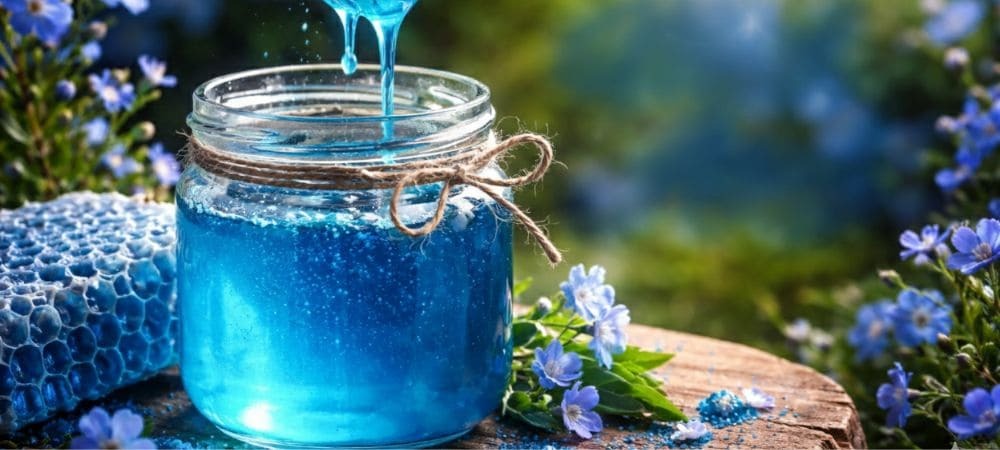
Behind that electric blue color and suggestive name lies a classic practice in the mycology world: preserving psilocybe mushrooms in honey. No modern alchemy or strange inventions. Just nature + patience + a well-sealed jar.
Honey preservation is a technique documented since ancient times for its antimicrobial properties, historically applied to various foods and natural preparations.
There is no trick here. What you see happens when the active compounds of mushrooms interact with one of the strongest natural preservatives available. If you want to know why it turns blue, why everyone is talking about it, and how to prepare it safely, keep reading.
What is blue honey and why has it gone viral?
Blue honey is basically honey mixed with dehydrated psilocybe mushrooms, usually from the Psilocybe genus. The mixture is left to rest, and over time, the visual “magic” happens: the honey gradually turns blue or purple. Technically speaking, blue honey is a mycological preparation that preserves dehydrated psilocybe mushrooms in natural honey, where a blue coloration appears over time due to oxidation of their compounds.
Why is it so popular today? TikTok, Reddit, and online forums where people are amazed by how something as simple as honey can change color naturally.
The explanation is completely natural. Psilocybin-containing mushrooms oxidize when handled. This oxidation releases a bluish pigment. This color change is a well-known mycological phenomenon when fungal tissues oxidize. When submerged in honey, the process is slower… but it still happens, and it becomes visible.
Not all mushrooms that turn blue contain psilocybin; some bluish species are completely different and potentially dangerous. Likewise, not all honeys react the same way. Floral composition, pH level, and filtration degree influence the final color intensity.
This is not “magic honey,” nor a chemical product. It is a natural preservation method valued for being discreet, long-lasting, and elegant. What started as a visual curiosity has become one of the preferred ways to preserve mushrooms without complications.
Why use honey to preserve mushrooms?
Honey is not just sweet. It is one of the oldest natural preservatives known to humans. Unlike alcohol or freezing, honey protects active compounds without exposing them to solvents or sudden temperature changes. Low moisture, acidic pH, and high sugar content create an environment that bacteria and mold dislike.
Combining honey + dried mushrooms results in a very effective preservation method. What are the advantages?
- Lasts for months (or longer) without losing properties
- Protects against humidity and reduces contamination risks
- Easy dosing (a single teaspoon says it all)
- Tastes better than eating dried mushrooms alone
- Versatile use: teas, yogurt, or directly as is
In summary, blue honey is not only attractive because of its color. It is practical, discreet, and performs well as a preservation method. A deeper blue tone does not imply greater potency: the color indicates oxidation, not a higher concentration of active compounds.
How to prepare blue honey
Ingredients
Equipment
Method
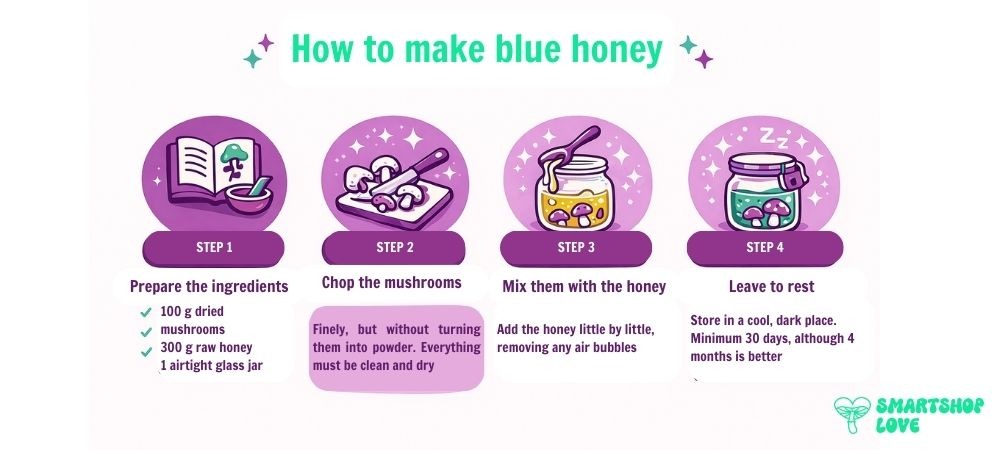
- Chop the mushrooms into small pieces, but do not grind them into powder.
- Place them in the jar, forming a base layer.
- Add the honey gradually, stirring slowly to avoid air bubbles.
- Seal the jar tightly and store it in a cool, dark, and dry place.
- Wait at least 30 days. Over time, blue coloration will start to appear.
Notes
Tried this recipe?
Let us know how it was!The color does not appear overnight. Patience is key here. Temperature, quantity, and humidity all play a role, so let nature do its work.
Smartshop Love Tip: if the honey crystallizes, do not heat it excessively. Use a gentle double boiler, keep the jar closed, and do not exceed 40 °C (104 °F).
How long does blue honey last and how should it be stored?
When properly prepared and stored, blue honey can last between 6 months and one year without problems. Keep the jar tightly closed, away from direct sunlight, and in a dry place. Using dry utensils when extracting honey significantly reduces contamination risk.
The appearance of persistent foam or liquid separation usually indicates residual moisture and an improperly controlled process. If you notice strange odors, bubbles, or unusual changes… do not take risks. Discard it.
For dosing, many people estimate how much mushroom is contained per teaspoon. Note: potency may vary depending on the variety and proportion. It is better to proceed slowly and avoid overconsumption.
Important: this preparation is not a food product or recreational substance. It is a mycological preservation technique intended for educational and informational purposes.
Effects and precautions (straight facts)
Blue honey preserves the active compounds of mushrooms, so the effects are similar to classic oral ingestion, although they are usually perceived as more gradual and smoother.
Possible effects may include:
- perceptual changes
- introspection
- mild euphoria
Everything depends on concentration and quantity.
Do not mix with alcohol or other substances. Do not drive or perform tasks requiring full attention. Always stay in safe environments and keep it out of reach of children and animals.
Psilocybin is regulated or prohibited in many countries. This information is provided for educational purposes only.
Blue honey: ancient technique, modern phenomenon
Blue honey has evolved from a curious video trend into a real technique used in mycology and its various mycological studies. Beyond its color, it is an ingenious way to preserve mushrooms while maintaining their integrity.
In the end, it is simply a historical collaboration between bees and fungi, each doing its job for centuries.
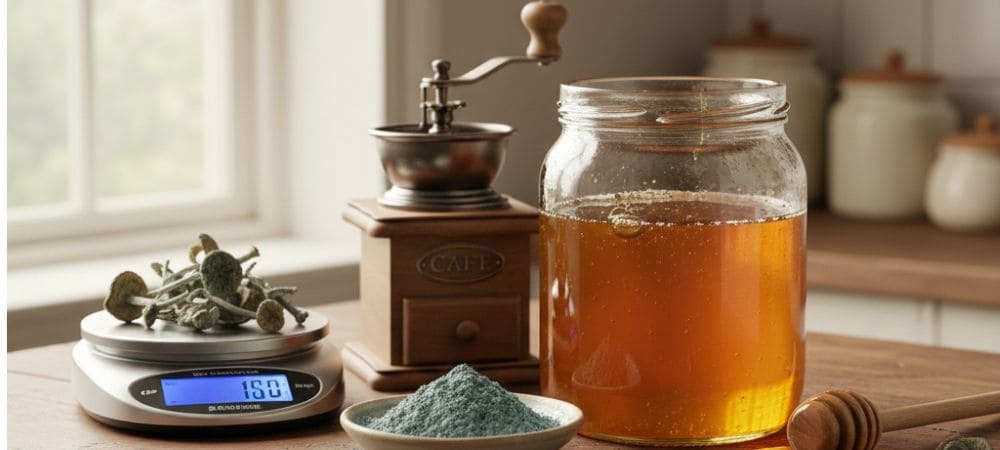
At Smartshop Love we promote knowledge, curiosity, and responsible education. Blue honey is just another example of how nature can outperform human ingenuity.