
In recent years, Psychedelic Therapy has evolved from a marginal concept into one of the most talked-about topics in the field of mental health. We are no longer just talking about studies in remote laboratories: today there are clinical trials, specialized professionals, and projects that are beginning to pave the way. There is even open discussion about Psychedelic Therapy in Spain, something that would have been unthinkable just a decade ago.
But amid all this growing interest, a question naturally arises: does Psychedelic Therapy require hallucinations to work? Or can therapeutic benefits be achieved without experiencing those intense visual or sensory effects?
What Psychedelic Therapy really is
Although the term may sound complex, the idea is easy to understand. Psychedelic Therapy combines three elements:
- A psychedelic substance (psilocybin, ketamine, MDMA, LSD…).
- A therapeutic process guided by professionals.
- A safe environment where the person can explore emotions, memories, or thought patterns from a different perspective.
Many people associate these therapies with hallucinations: vivid colors, visions, unusual sensations… Yes, these effects can appear, but the most interesting part is not limited to that. Important changes occur within the brain that seem to be a key part of their therapeutic potential.
In fact, studies on psychedelic-induced neuroplasticity show that these substances can reorganize the brain in highly beneficial ways, beyond the subjective experience. Research indicates that psychedelics:
- Increase neuroplasticity (the brain’s ability to reorganize itself).
- Relax rigid mental patterns associated with anxiety or depression.
- Allow access to deep emotions.
Reduce brain activity linked to fear and stress.
The big question is whether these benefits only occur when hallucinations are present, or whether they can also arise from doses or compounds that do not produce intense perceptual changes.
Why this debate is so important
The answer is not only relevant to scientists or therapists. It could completely transform our relationship with mental health. If the benefits of psilocybin therapy or other substances did not depend on hallucinations, everything would change:
- Treatments would become more accessible and easier to implement.
- We would be talking about safer therapies suitable for a wider range of patients.
- Psychedelic-assisted therapy could become normalized much more quickly.
- Regulation in countries like Spain would progress with fewer obstacles.
- Social stigma would decrease, as people would no longer fear “losing control.”
That is why more and more experts are analyzing which part of the therapeutic effect depends on subjective experience and which part comes from the deep changes occurring in the brain.
What science says about this treatment
Research into Psychedelic Therapy is advancing at a pace that would have seemed impossible just a few years ago. Each year brings new studies, hypotheses, and ways of understanding how these substances act on the brain and human experience.
Although there is still a long way to go and no absolute consensus, we already have clear clues that help structure this debate. Broadly speaking, current science revolves around two main perspectives:
1. The classic view: hallucinations are essential
For decades, it was believed that intense subjective experiences—deep thoughts, new sensations, visions, or powerful emotional moments—were at the core of Psychedelic Therapy.
Many patients report profound, life-changing experiences that alter how they see themselves or cope with trauma. Some studies even show that the more intense the experience, the greater the improvement.
This led to the belief that without hallucinations, Psychedelic Therapy would not work as effectively. However, this view is now evolving.
2. The modern idea: the brain can change without hallucinations
In recent years, a surprising discovery has emerged: the beneficial effects of psychedelics can occur even without hallucinations.
Psychedelics may generate positive neural changes without producing intense perceptual experiences.
Many compounds activate mechanisms that:
- Increase neuroplasticity.
- Reduce mental rigidity.
- Decrease symptoms of anxiety or depression.
- Enhance emotional connection.
This has driven the development of so-called non-hallucinogenic psychedelics, which could revolutionize Psychedelic-assisted therapy as we know it.
So… does Psychedelic Therapy work without hallucinations?
The most honest answer is yes—there is evidence that it can work, although not in the same way or with the same results for everyone.
Let’s break it down:
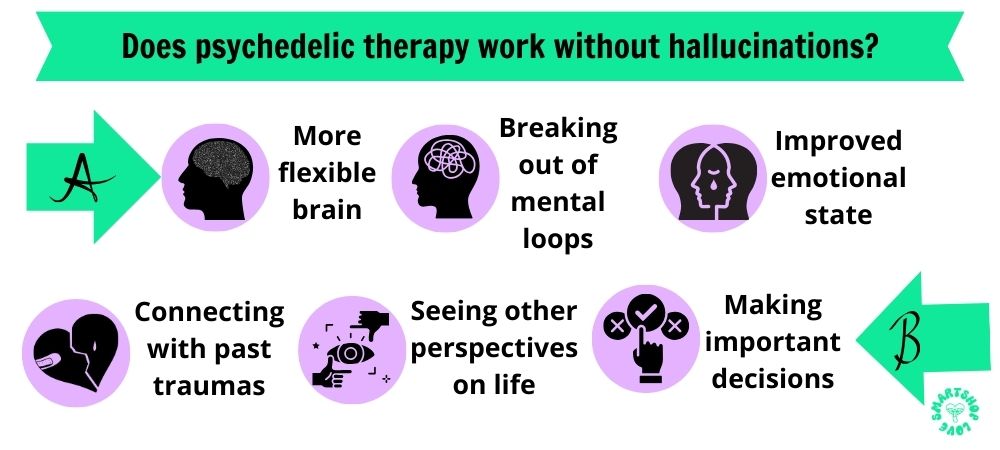
A) Biological changes can occur without hallucinations
This has already been demonstrated in various scientific studies. Many molecules produce benefits in the brain without causing intense visual or sensory experiences.
In other words:
- The brain becomes more flexible.
- The person breaks out of negative mental loops.
- Emotional state can improve.
All of this can happen without seeing colors, shapes, or visions.
B) Deep psychological changes depend more on the experience
This is where experts do not fully agree. For some people, the emotional and perceptual experience is very important.
It helps them to:
- Connect with past trauma.
- See their life from a new perspective.
- Release blocked emotions.
- Make important decisions.
For others, however, benefits appear without the need for an intense psychedelic journey.
Ultimately, hallucinations are not always necessary, but in some cases they can enhance the therapeutic process.
Real examples of therapies that work without hallucinating
Although it may seem like a new or even hard-to-imagine concept, the truth is that there are already treatments showing that the benefits of Psychedelic Therapy can occur without the need for an intense visual or sensory “trip.” These approaches are active today in clinics, clinical trials, and laboratories worldwide.
1. Low-dose ketamine: Many clinics use ketamine to treat resistant depression without causing strong hallucinations.
2. MDMA in assisted therapy: Although it does not produce visions, it reduces fear and opens the door to deep emotional work.
3. Psilocybin microdosing: Many people experience improved mood and concentration without any hallucinations. Research is still ongoing, but scientific interest is very high.
4. New non-hallucinogenic psychedelics: New compounds based on psilocybin and LSD are being developed and could completely reshape the future of Psychedelic Therapy in Spain and worldwide.
What Will the Future of These Therapies Look Like?
All signs suggest that two complementary approaches will coexist:
1. Full Psychedelic-Assisted Therapy
For individuals seeking deep therapeutic work. This approach is designed for trauma, severe depression, addictions, and similar conditions. Here, the subjective psychedelic experience may be an important part of the healing process.
2. Non-Hallucinogenic Psychedelics
Ideal for moderate anxiety, mild depressive symptoms, emotional blocks, or individuals who do not wish to undergo an intense psychedelic experience.
This will make psychedelic-assisted therapy much more accessible.
The future will be hybrid, more flexible, and significantly safer. And yes, psychedelic therapy in Spain will likely follow this trend as clinical trials progress and regulations evolve.
What Someone Interested in These Therapies Should Understand
- Hallucinations are not required to experience therapeutic benefits.
- The full psychedelic experience can be transformative, but it is not the only path to healing.
- The future of psychedelic therapy will be more diverse and flexible.
- Research in Spain is advancing, and it is only a matter of time before more regulated treatment options become available.
- The ideal approach depends on the individual and their emotional history.
The question, “Can psychedelic therapy work without hallucinations?” does not have a simple yes-or-no answer. What current evidence suggests is that a significant portion of the therapeutic effects—especially those related to neuroplasticity, emotional regulation, and cognitive flexibility—may occur without hallucinogenic experiences.
However, research also indicates that, in certain deep therapeutic processes such as complex trauma or existential crises, the full psychedelic experience may provide additional benefits that are not always replicated by non-hallucinogenic alternatives.
The most prudent conclusion today is that both approaches have value, are not mutually exclusive, and that the future of psychedelic therapy will likely be hybrid, combining options with and without intense perceptual effects based on the needs of each individual and each clinical situation.
FAQs About Non-Hallucinogenic Psychedelic Therapy
What is the difference between psilocybin microdosing and a full therapeutic dose?
These are very small amounts that do not cause hallucinations. They may subtly improve mood, mental clarity, or concentration. They do not produce a full psychedelic experience.
Full therapeutic dose:
Used in guided therapeutic sessions, it can produce perceptual changes, deep introspection, and intense emotional processing.