
Hallucinogenic mushrooms, also known as “magic mushrooms” or “psilocybes“, are species of fungi that contain psychoactive compounds capable of altering perception, mood, and cognitive processes. Their use dates back to ancient and ceremonial cultures, but in recent decades they have also attracted interest in scientific and recreational contexts.
While they spark curiosity in many people, there is still considerable uncertainty about the effects of hallucinogenic mushrooms and what exactly happens in the body when they are consumed.
What do hallucinogenic mushrooms contain and how do they work?
Most psychoactive mushrooms contain psilocybin, a compound that the body converts into psilocin, the molecule responsible for the psychedelic effects. This substance primarily acts on the serotonin receptors in the brain, a neurotransmitter essential for regulating mood, perception, and cognition.
When psilocin binds to these receptors, especially the 5-HT2A receptor, it changes the way neurons communicate. This not only increases activity in certain brain areas but also reduces the “rigidity” of some habitual mental patterns.
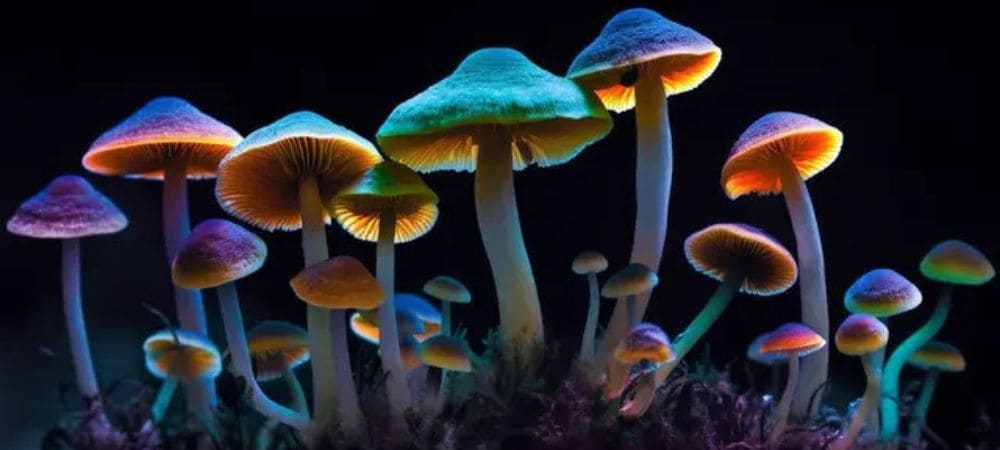
The effects of hallucinogenic mushrooms result in senses, emotions, and thoughts being experienced in a very different way than usual.
How long do hallucinogenic mushrooms take to take effect?
After consumption, effects usually begin within 20 to 60 minutes, depending on factors such as:
- The species and potency of the mushroom.
- The amount consumed.
- Whether it is ingested on an empty or full stomach.
- Individual sensitivity.
The full effect usually lasts between 4 and 6 hours, although higher doses can extend up to 8 hours.
Main effects of hallucinogenic mushrooms on the body and mind
The effects of hallucinogenic mushrooms can vary greatly from person to person. Not everyone experiences the same effects, and a single person may have very different experiences at different times. Still, there are some common effects that are often reported.
1. Changes in visual and sensory perception
This is the most well-known effect of hallucinogenic mushrooms. People may experience:
- More intense and vivid colors.
- Waving or movement in static objects.
- Geometric patterns with eyes closed.
- Distortion of the size or shape of objects.
- Heightened sensitivity to light, sounds, or touch.
These changes are not full hallucinations in most cases, but rather alterations in the perception of real stimuli.
2. Altered perception of time
It is common to feel that time slows down or speeds up. Minutes may feel like hours, or the opposite. This change is due to a temporal reorganization of brain processing.
3. Changes in emotional state
Psilocin can amplify emotions, both positive and negative. Common emotional effects include:
- A sense of well-being and connection.
- Spontaneous laughter or euphoria.
- Increased introspection and reflection.
- A feeling of unity with the environment.
- Anxiety or confusion in some cases.
For this reason, it is often said that the “trip depends on the mindset,” since prior emotions strongly influence how the experience unfolds.
4. Changes in thought patterns
Under the influence of hallucinogenic mushrooms, many people report:
- More fluid and creative thinking.
- Changes in how they view everyday situations.
- A sense of mental clarity or deep understanding.
- Repetitive thoughts if experiencing anxiety or discomfort.
Neuroscientifically, this happens because psilocin reduces activity in the default mode network, associated with internal chatter and automatic mental patterns. With this network less active, thought patterns become less rigid.
5. Physical effects of hallucinogenic mushrooms
Although the most prominent effects are psychological, physical changes can also occur:
- Dilated pupils.
- Slight loss of balance.
- Initial nausea.
- Increased body temperature.
- Mild sweating.
- Changes in heart rate (usually minor).
These physical effects are usually temporary and fade as the experience progresses.
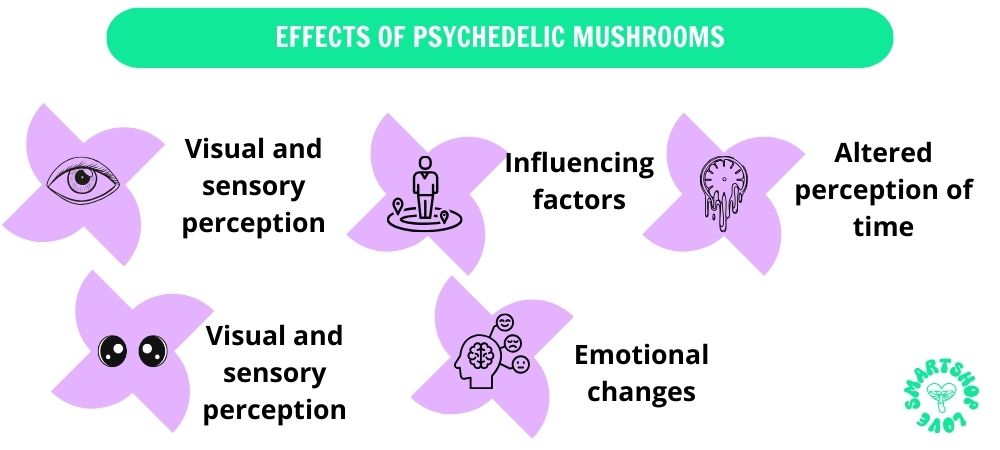
Why does each person experience hallucinogenic mushrooms differently?
The effects of hallucinogenic mushrooms depend not only on the substance itself but also on two key factors:
The individual’s internal state
This includes mood, personality, mental health, and expectations. A calm person in a positive emotional state usually has a more pleasant experience. If consumed during stress or fear, discomfort is more likely.
The environment when consuming hallucinogenic mushrooms
The setting also plays a huge role. A safe, comfortable, and supportive environment minimizes risks. An unfamiliar, hostile, or overstimulating environment can cause anxiety.
That is why therapeutic or ceremonial contexts carefully manage lighting, music, and company.
Risks and unwanted effects
Although hallucinogenic mushrooms rarely cause physical dependence and have low toxicity compared to other substances, they are not risk-free.
Common negative effects of hallucinogenic mushrooms include:
1. Bad trip or unpleasant experience
These can include:
- Intense anxiety.
- Fear or paranoia.
- A feeling of loss of control.
- Recurrent negative thoughts.
These episodes are usually linked to a poor emotional state or an unsuitable environment.
2. Nausea and physical discomfort
Especially at the beginning. Some species or preparations are harder to digest than others.
3. Disorientation
During the peak of the effects, some people may lose spatial awareness or coordination, so strenuous physical activities should be avoided.
4. Risks for people with mental health issues
People with disorders such as severe anxiety, bipolar disorder, or schizophrenia may experience worsening symptoms. Therefore, use is not recommended in these cases without professional supervision.
Do hallucinogenic mushrooms have long-term effects?
For most occasional users, the effects of hallucinogenic mushrooms do not last beyond a few hours. However, there are some points to consider:
- Positively, some scientific studies suggest that psilocybin can lead to improvements in emotional well-being, creativity, or sense of life purpose lasting for weeks. These findings are linked to clinical settings, not recreational use.
- Negatively, in predisposed individuals it could trigger prolonged anxiety or psychological stress. A rare phenomenon called HPPD has also been reported, involving persistent visual disturbances.
Still, these cases are rare and usually appear with high, frequent, or combined substance use.

Can tolerance develop?
Yes. Psilocybin builds tolerance quickly. If consumed on consecutive days, its effects decrease significantly. The body typically needs 10 to 14 days to regain normal sensitivity. This reduces the risk of continuous abuse, but responsible use is still important.
Are hallucinogenic mushrooms addictive?
Hallucinogenic mushrooms rarely cause physical addiction and have a very low potential for psychological dependence compared to stimulants or depressants. In fact, their rapid tolerance and the emotional intensity of the experience make them substances most people do not want to use frequently.
What do current studies say?
In recent years, researchers from universities like Johns Hopkins and Imperial College London have studied psilocybin for therapeutic purposes. Preliminary results suggest potential benefits for:
- Treatment-resistant depression.
- Anxiety in patients with serious illnesses.
- Post-traumatic stress disorder (PTSD).
- Addictions such as tobacco or alcohol.
However, these studies are conducted in controlled environments, with precise doses and professional supervision. They should not be directly applied to recreational use.
What effects do they have on the body?
Hallucinogenic mushrooms produce a combination of sensory, emotional, and cognitive effects that can vary greatly between individuals and situations. Experiences range from enhanced connection and creativity to episodes of confusion or anxiety if mental state or environment is not ideal.
Although their toxicity is low and they rarely cause dependence, they are not risk-free, especially for vulnerable individuals or in irresponsible contexts. Understanding how they work and which factors influence the experience is key to approaching this topic with knowledge and safety.
FAQ about the effects of hallucinogenic mushrooms
Can hallucinogenic mushrooms interact with common medications?
Yes. Some drugs, especially antidepressants, anxiolytics, or MAO inhibitors, can modify or intensify the effects of psilocybin. It is always important to avoid combinations without medical supervision.
What is the difference between microdosing psilocybin and taking a recreational dose?
Microdosing involves taking very small amounts that do not produce psychedelic effects, while a recreational dose causes full changes in perception and cognition.
Can the exact potency of a hallucinogenic mushroom be determined just by appearance?
No. Psilocybin concentration varies between species, cultivation methods, and even between mushrooms from the same batch, so visual appearance is not a reliable indicator.
Do dried and fresh mushrooms produce different effects?
Yes. Dried mushrooms generally have a higher concentration per gram, while fresh mushrooms contain more water and require higher doses for a comparable effect.
Does prior food intake affect the intensity of the trip?
Yes. Taking them on an empty stomach usually accelerates and intensifies the effect, while after a heavy meal the effects may be slower and milder.