
Let’s start by clarifying something basic: growing magic mushrooms is not a TikTok trick or a weekend experiment. It’s mycology. And mycology, although fascinating, follows clear rules, timelines, and limitations.
The internet is full of searches like “how to grow hallucinogenic mushrooms” or “how to grow magic mushrooms at home.” That’s normal. When someone discovers the world of fungi, curiosity skyrockets. The problem is that many explanations mix biology, legal issues, and fantasy as if everything were the same.
This text takes a different approach. Here we explain how mushroom cultivation works from an educational and biological perspective, what materials are generally used, what the life cycle of a fungus looks like, and why the legal context matters more than many people think.
The legal framework of hallucinogenic mushrooms: why it is so important
Before talking about mycelium, substrates, or humidity, we must talk about the law. This is where many people become overconfident… and then run into trouble. Psilocybin and psilocin are classified as controlled substances at an international level. That is why:
- Growing hallucinogenic mushrooms to obtain these substances is illegal.
- Possession of fresh or dried psilocybin mushrooms can also lead to penalties.
- Legally sold grow kits are intended only for non-psychoactive mushrooms.
Some European countries and certain U.S. states have changed or relaxed their regulations, but this is a constantly evolving area that requires staying up to date. In Spain, the framework is that growing psychoactive mushrooms for sale or distribution is not allowed. The condition in Spain for growing the famous “magic mushrooms” is that it must be strictly for personal use and not for any profit-making purpose.
That’s why this content is educational, not instructional. Understanding how a fungus works does not mean you are allowed to produce controlled substances.
2. Understanding the life cycle of a magic mushroom
To understand how to grow any mushroom, whether edible, medicinal, or decorative, it is essential to understand how a magic mushroom develops. The process, explained simply, follows these steps:
- Spores: Tiny particles that act like “seeds,” although they are not technically seeds.
- Germination and mycelium: A spore landing on a suitable substrate germinates and forms hyphae, which interconnect to create the mycelium, the true structure of the fungus.
- Substrate colonization: The mycelium consumes nutrients and spreads. If everything goes well, the container becomes covered by a white, cotton-like network.
- Fruiting: When environmental conditions change—more light, more oxygen, high humidity—the mycelium produces mushrooms.
- Reproduction: Those mushrooms release new spores, restarting the cycle.
This process is common to virtually all species, including legal mushrooms and hallucinogenic varieties.
3. Common materials for mushroom cultivation
No matter which mushroom species you want to grow, the foundation is very similar. The most common materials for growing hallucinogenic mushrooms are:
- Spores or liquid mycelium (from edible or medicinal species)
- Substrate: coconut coir, vermiculite, grains, compost
- Glass or plastic containers
- Sprayer or humidifier
- Gloves, mask, and alcohol to maintain hygiene
- Fruiting chamber or “fruiting chamber”
All of this can be easily purchased from specialized stores such as gbthegreenbrand.com.
4. How to grow hallucinogenic mushrooms step by step
Although many people search for how to grow magic mushrooms, the cultivation technique is the same as that used for common species like oyster mushrooms or adaptogenic mushroom varieties such as shiitake.
4.1. Substrate preparation
The substrate is the medium where the mycelium will grow. To work properly, it must be clean and free of competing microorganisms. Typically, you should:
- Mix coconut coir and vermiculite, or grains such as rye.
- Moisten it until it reaches a spongy texture.
- Sterilize the mixture for 60–90 minutes in a pressure cooker.
Sterility is the key to success.
4.2. Inoculation of hallucinogenic mushrooms
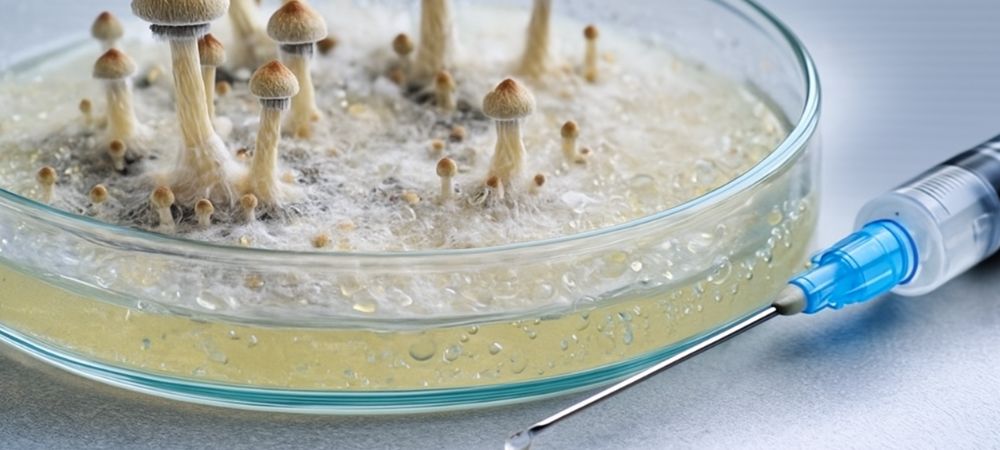
Once the substrate has cooled, the mycelium or spores are introduced. This is done using sterile syringes and holes in the lid of the container.
For successful inoculation, strict hygiene is mandatory. Keep your hands clean, wear gloves, and use alcohol to disinfect surfaces when needed. Any mistake at this stage can lead to contamination and crop loss.
4.3. Colonization
To grow mushrooms for mycological study, the inoculated container should rest in a relatively warm place (72–79 °F), away from direct light. Gradually, the mycelium will colonize the substrate. This stage can take between one and three weeks depending on the species. Once everything is white and uniform, you move to the next step.
4.4. Fruiting
Fruiting occurs in a humid and well-ventilated environment. Typical conditions include:
- High humidity (80–95%)
- Soft light (not direct)
- Air exchange
- Temperatures around 64–75 °F
When the mycelium detects these conditions, it begins forming small pins that later develop into mushrooms.
5. Key Factors for How to Grow Hallucinogenic Mushrooms in Mycological Study
Lighting
Lighting is one of the most important factors in mushroom cultivation, especially when studying hallucinogenic mushrooms, as they are extremely sensitive to excessive light. It is important to note that although they can be exposed to natural light or artificial light (white and cool), they should never be exposed to direct light. Light should be ambient. This is because mushrooms naturally grow surrounded by tall, dense trees that leave them in near darkness. The goal is to recreate their natural habitat.
Humidity
Humidity is the key factor to activate the mycelium. The best way to maintain proper humidity is to use a propagator or a grow bag, and above all, to mist with bottled water. Tap water should never be used for misting.
Temperature
Temperature is a determining factor in the cultivation of hallucinogenic mushrooms for mycological study, since mushrooms are typically grown at temperatures between 21°C and 24°C (70°F–75°F).
How to grow hallucinogenic mushrooms therefore depends on temperature. This means that if cultivation is carried out in colder environments or during low-temperature periods, heating devices or heat mats will be needed to provide warmth to the fungi.
Cleanliness in Cultivation
Although growing hallucinogenic mushrooms may appear visually “messy,” it is quite the opposite. They require a clean and fully sterile environment.
6. Common Problems in Cultivation
The most common mistakes among beginners are:
- Mold spots (green or black) → contamination
- Unusual odors → bacteria
- Excess humidity → standing water, suffocated mycelium
- Lack of airflow → deformities
- Unstable temperatures → slow growth
Growing hallucinogenic fungi for mycological study may seem simple, but it requires patience and strict cleanliness.
7. Health Risks
It is important to remember that the idea that “natural mushroom = safe mushroom” is false. Psychoactive fungi can produce intense psychological experiences. They can also cause poisoning, interact with medications, or be mistaken for toxic species if not properly identified.
Learning how to grow hallucinogenic mushrooms from a mycological perspective is completely valid. Mycology is a fascinating field, and understanding how a fungus develops—from a spore to a fully formed mushroom—is truly remarkable.